

Blog

Have you ever been to a website that takes forever to load?  What do you do?

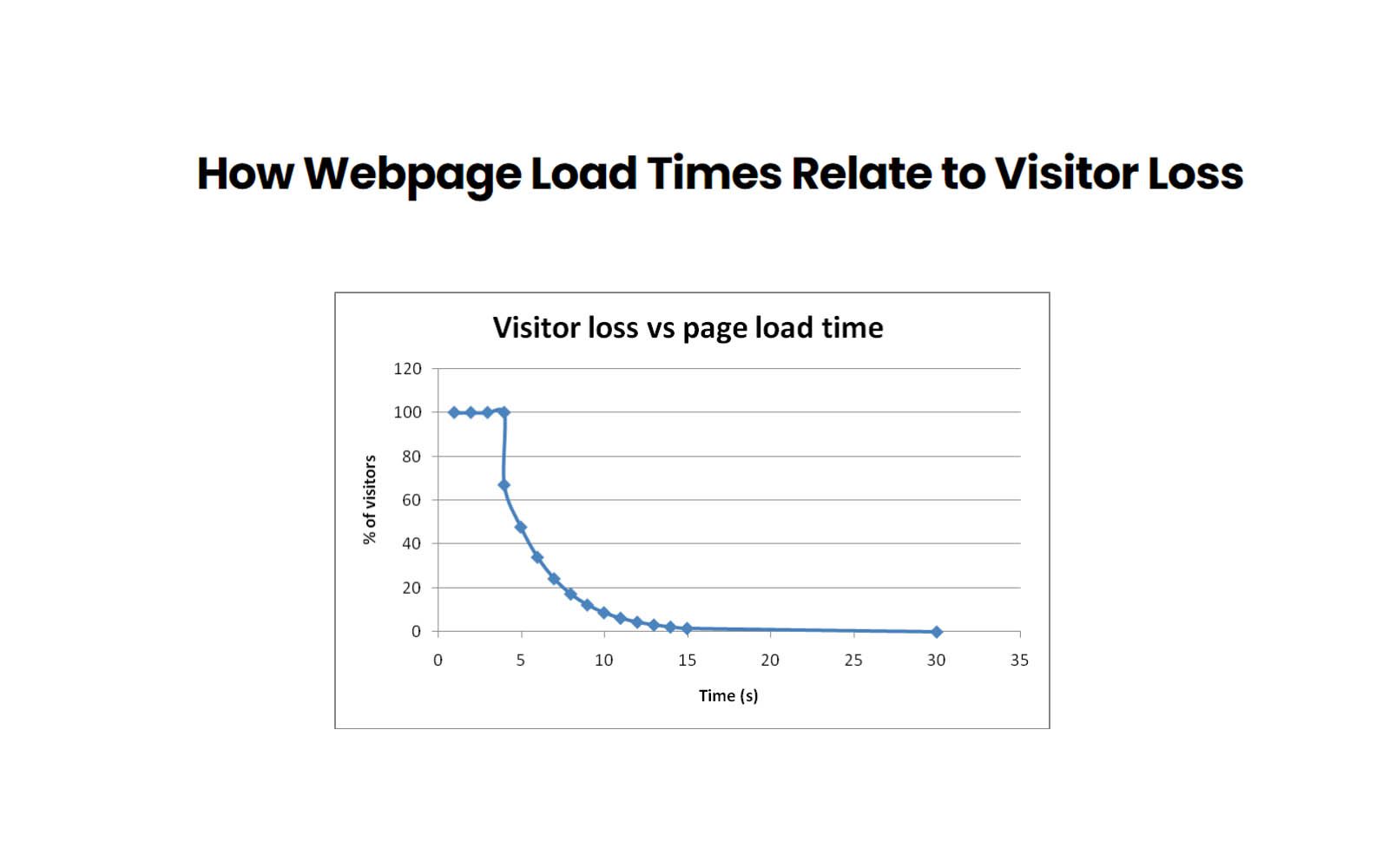
We’ve taken some past research and developed a way to determine how many visitors you could potentially be losing based on how long your website takes to load from 0-30 seconds.  This was not easy – only a couple of studies have actually been done, and not only are they “aging”, but they have also been controversial and only up to around the first 4 seconds of load time data.  Obviously, there are many factors involved in determining how long you are willing to wait for a page to load, but with tabbed browsing, faster connections speeds, and more, maybe this is why a real study has not been done since 2006.

Here are some key takeaway points from the research we were able to come up with:

- Zona research said in 1999 that you could lose up to 33% of your visitors if you page took more than 8 seconds to load.
- Akamai said in 2006 that you could lose up to 33% of your visitors if your page took more than 4 seconds to load on a broadband connection.
- Tests done at Amazon in 2007 revealed that for every 100ms increase in load time, sales would decrease 1%.
- Tests done at Google in 2006 revealed that going from 10 to 30 results per page increased load time by a mere 0.5 seconds, but resulted in a 20% drop in traffic.

Wow.  A half of a second?  Is that even enough time to take a breath? Yet, when browsing, most people will lose patience and leave your website before they even have time to breathe.   How this relates to e-commerce sites is pretty important. If your website is selling a fairly generic item, your site had better load pretty damn fast or you just lost your sale to some other guy. At Christmas, when every parent is looking for this seasons must have toy, better hope your website loads in under 2 seconds. When a husband forgets his anniversary and is quickly looking for a flower delivery place while the boss isn’t looking, your pictures better not be too big and take forever to load.

So how long does your webpage take to load? Check out Pingdom.com/Tools, and then come back here and approximate your potential visitor loss:

If you prefer to “geek out” and read our entire white paper, you can download it here.  (I will warn you that it does mention words like “mathematical model”, “radioactive first oder decay” and “non-linear regression”.)


Sharing is Caring:
  • Digg
  • Sphinn
  • del.icio.us
  • Facebook
  • Mixx
  • LinkedIn
  • Ping.fm
  • StumbleUpon
  • Technorati

Would you like to try our free website analysis tool and get an instant report on your website in 30 seconds? No signup, no email to give, nothing to install.

Related Posts:

9 Responses

  1. -
    August 7th, 2009 at 2:55 pm

    Interesting and redundant.

    I managed to geek out for a while and read your white paper and some of the referenced material. I would like to add some points.

    Exponential function (or the radioactive decay function, as you have written) is a very standard function to describe many scientific phenomena. So it’s understandable that you assumed it applicable for your case. However, even a Pareto function, which is more widely used in cases of demographic, economic and psychological phenomena, would have served the purpose. Or for that matter, there are numerous other functions that are similar in nature/shape and a simple curve fitting exercise would give out a number of different results.

    Moreover, in certain cases (like when buying flight tickets, or books, or apparel) most customers would choose to search and hang around a while longer if they can strike a better deal. So, while a researcher managed to establish that 40% of online shoppers preferred sites which loaded faster, did he actually address the bias that comes with sampling (price range of products purchased, types of products, and some other factors)? In other words, was the sample representative of all the shoppers and products?

    Again, tolerable wait time is dependent on a lot of factors, as established in earlier research (for example, feedback on the page load time increases the tolerable wait time to 38 seconds, and I am quoting from one of your sources). There are a lot of flash heavy websites which are amazing to be on and I would love to shop on one of those (have a look at some webby winning websites). Moreover, web traffic might not be a very accurate indicator of the actual sales because there might be a lot of users who were actually “e-window shopping” or who stumbled upon the page.

    The point is that it’s redundant to model the number of users lost over a 30 second time period. That probably is one reason why much research has not been done in this area after 2006. It’s actually fascinating to quantify something as abstract and complicated as human behavior yet in this case it’s not very accurate as a case by case approach would be more relevant. What this paper would sum up to is “if you are selling something trivial, better keep your web pages as light as possible”.

  2. Romy Misra
    August 7th, 2009 at 5:02 pm

    A lot of research was put into what curve to choose and we did take into consideration the Pareto curve in the preliminary analysis.

    The problem with the Pareto curve was that apart from the minimum value of x defined as 4 it had only one parameter. We had 2 other points we knew the curve had to pass through. So this creates a situation of infinite Pareto curves, not passing through all the points we know the curve has to pass.

    The radioactive decay on the other hand was found the best approximation with the least error percentage when fit into previous years data. Which made it the best approximation to choose from a predictive model perspective.

  3. -
    August 7th, 2009 at 7:13 pm

    Thanks for the clarification on curve selection.

  4. Men's Citizen Watches
    December 22nd, 2009 at 12:06 pm

    Great write up – five stars. I bookmarked this page.

  5. Meridith Pippenger
    December 22nd, 2009 at 1:11 pm

    Hey. I got a 502 gateway error earlier today when I tried to access this page. Anyone else had the problem?

  6. Coleen Valenzuela
    December 27th, 2009 at 6:37 pm

    Went through your post and thought hey, someone was really good in debate classes.

  7. quel film
    December 30th, 2009 at 12:03 pm

    It was a nice post you wrote, keep updating your site, that’s nice.

  8. Randal Lesky
    April 9th, 2010 at 11:21 am

    good post, raises valid points

  9. Jan Amsel
    April 23rd, 2010 at 8:55 am

    Normally I do not commence opinion my personal English just isn’t up to speed. but yet thanks for this excellent blog post and hoping ahead to more.

Leave a Reply

Note to commenters: please use your name, handle, nickaname - I don't care if it's a fake name - but if you use a "keyword you're trying to rank for" - we will NOT approve your comment.